

PMOs are under more pressure than ever to create clarity, consistency and confidence across increasingly complex delivery environments. Expectations have risen, but many teams are still working with fragmented tools, manual reporting processes and governance models that add effort without always improving outcomes. The challenge is no longer simply managing projects well. It is helping the organisation make better delivery decisions in a far more challenging environment.
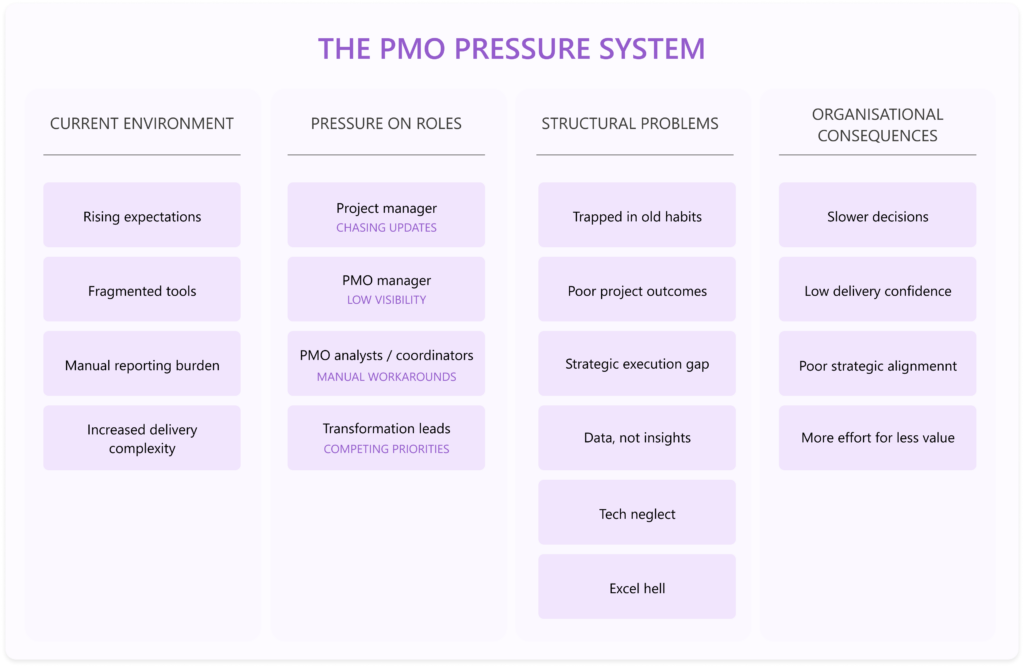
That reality is showing up every day for project managers, PMO leaders, analysts and transformation teams. Too much time is still being spent chasing updates, reconciling spreadsheets, managing inconsistent reporting and trying to hold delivery together across disconnected systems. Many PMOs are working harder to create visibility but not always gaining more confidence in return. At the same time, leadership expects stronger prioritisation, better visibility and clearer evidence that delivery effort is supporting strategic outcomes.
This article looks at the current state of the PMO through that lens. It explores the roles carrying the pressure, the structural problems sitting underneath day-to-day friction, and what better PMO environments are doing differently. It also outlines what to look for in a solution and partner when the goal is not just more control, but stronger delivery performance and better strategic confidence
The roles carrying the pressure
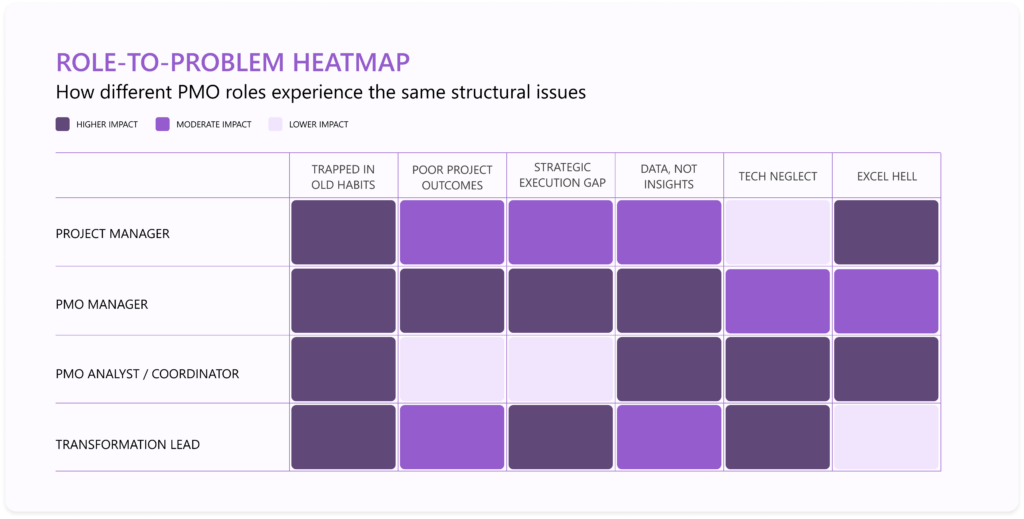
While every PMO environment is different, the pressure points are often surprisingly consistent. They tend to land hardest on the people closest to the work: those coordinating delivery, maintaining visibility, supporting governance and trying to turn a high volume of information into something leaders can trust and act on.
For project managers and PMO analysts, that pressure is often operational. They are the ones absorbing the admin load, chasing updates, stitching together fragmented information and trying to keep delivery moving despite inconsistent inputs. A significant share of PMO effort still sits in work that is necessary but low value, which limits the time available for better delivery, assessment, foresight and meaningful analysis.
For PMO managers and delivery leaders, the pressure is broader. They need to create confidence across the portfolio, balance governance with usability, ensure effective resource management, improve process adoption and help leadership trust what they are seeing. That means the PMO is carrying both operational friction and strategic expectation at the same time, which is why so many teams feel stretched between maintaining control and enabling better decisions.
Why these pains keep repeating
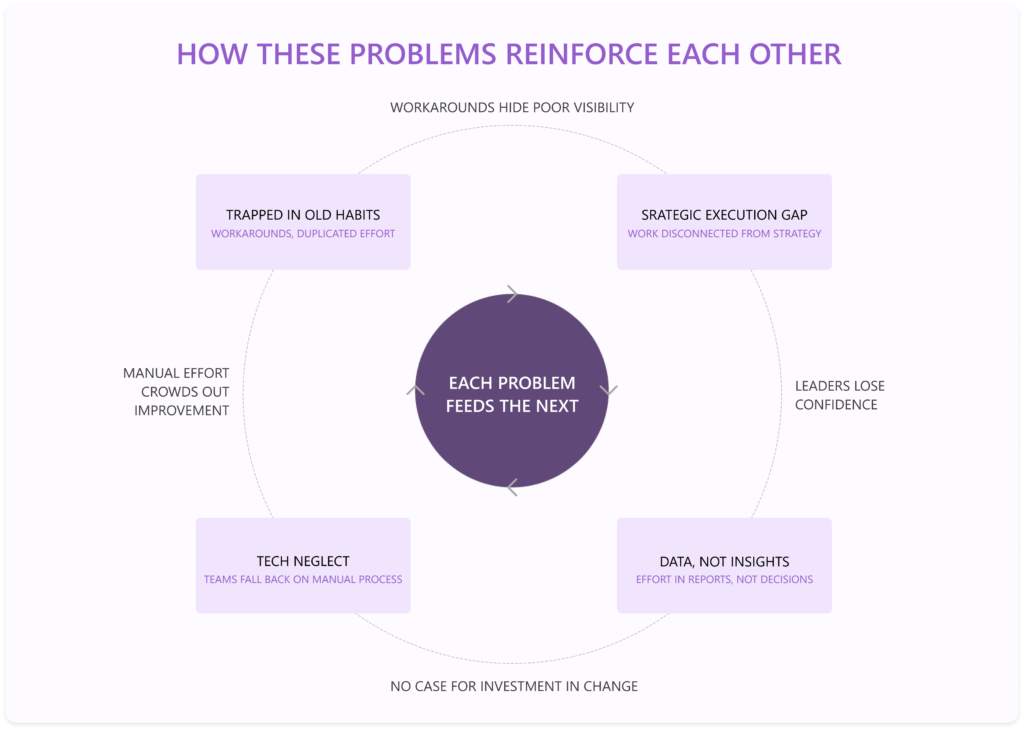
For many organisations, PMO frustrations are not isolated delivery problems. They are symptoms of a structural system that has quietly worked against itself over time. When reporting is slow, visibility is weak and teams feel burdened by process, the causes are usually interconnected and they tend to reinforce each other.
One of the clearest signs is a reliance on outdated habits. Being trapped in old ways of working, where familiar processes and legacy tools continue to shape delivery when they clearly no longer work, undermines the quality, efficiency and collaboration modern teams need. This often shows up as workarounds, duplicated effort and teams bending themselves around process instead of process supporting the work.
Those habits make it harder to close the next gap: the distance between delivery activity and leadership confidence. Many PMOs can report on progress, but not always in a way that helps leaders understand whether the right work is being prioritised, how investment is tracking against intended outcomes or where risk is building across the portfolio. Delivery may be happening, but the line of sight between work and organisational priorities remains weak.
That visibility gap has a direct effect on data quality. PMOs are often rich in status updates, trackers and reporting artefacts, but poor in trusted, connected information that supports timely decisions. When data is scattered across spreadsheets, slide decks and disconnected tools, effort goes into preparing information rather than using it, producing reports without improving clarity or supporting confident decision-making.
And without confidence in the data, it becomes harder to make the case for better tools. When platforms are underused, poorly connected or not designed around the reality of delivery work, teams fall back on manual processes. That administrative burden leaves little room to improve, which is how the cycle continues. Old habits persist, visibility stays weak and the same frustrations resurface.
Together, these four problems do not simply coexist. Each one makes the others harder to solve.
What better PMOs are doing differently
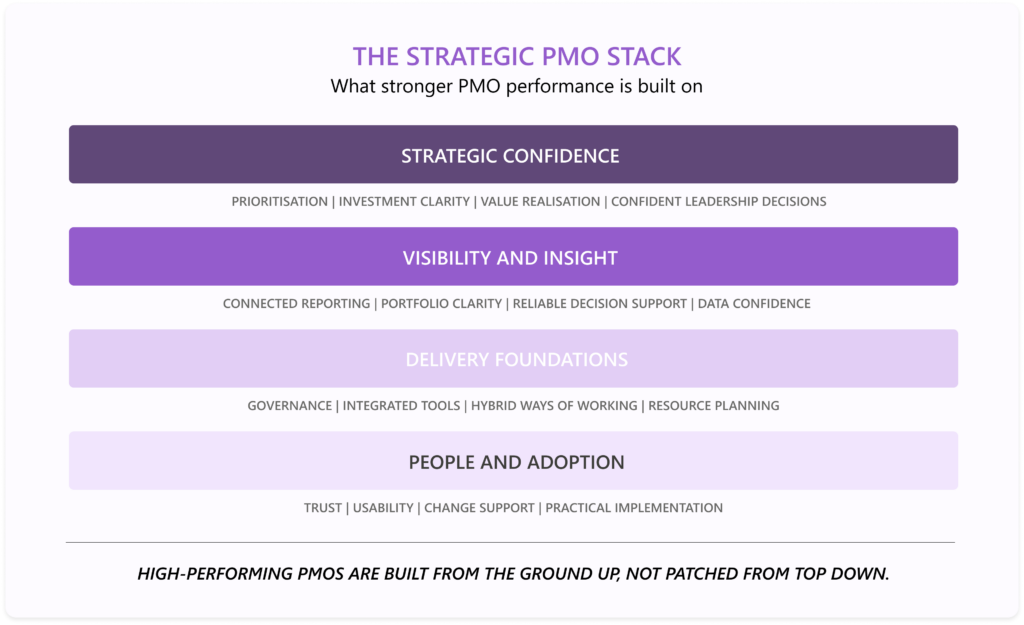
The strongest PMOs are not simply adding more controls or asking teams for more updates. They are improving the foundations that make delivery easier to see, manage and adapt. That usually starts with a more strategic view of PMO performance and a willingness to rethink how governance, visibility, tools and support are working together.
One important shift is treating the PMO as a strategic business function rather than an administrative one. The PMO Trends – white paper outlines that PMOs are increasingly expected to connect project execution with organisational priorities, support better portfolio structure decisions and demonstrate business value achieved, not just delivery activity. That change matters because it moves the PMO from administering and reporting on work to helping shape how work is prioritised, delivered and governed. Better PMOs are also moving away from one-size-fits-all delivery models. As the white paper notes, hybrid and adaptive delivery has become essential in environments where work spans formal projects, operational activity and cross-functional initiatives. Supporting different ways of working without losing consistency or oversight helps reduce friction for delivery teams while still giving leaders the visibility they need.
Another clear pattern is the move towards stronger data foundations. High-performing PMOs are replacing fragmented reporting with connected information that can be trusted across teams and leadership levels. They are also investing in more integrated delivery environments so that status, risks, financials, resourcing and progress are not being reconstructed manually each time someone needs an update. This is a key shift towards data-driven decision making, supported by unified PPM platforms, both of which help PMOs spend less time wrangling information and more time using it.
Resource management and practical automation are part of this picture too. PMOs that can see capacity more clearly, plan with more confidence and reduce repetitive effort are in a stronger position to support delivery without overloading teams or unnecessarily delaying new project starts. AI has a role here, but the most effective use is still grounded in good data, sensible process design and human oversight. The point is not to automate everything. It is to remove low-value effort, improve insights and create more space for strategic work.
What matters across all these shifts is not simply that PMOs are becoming more mature or more structured. It is that they are becoming more valuable. Strategy-led prioritisation reduces noise. Hybrid delivery support reduces friction. Integrated data reduces manual rework and rekeying errors. Better resource visibility improves forward planning and decision quality before delivery pressure turns into delivery risk. In other words, modern PMOs are succeeding because they make decisions more efficient, delivery easier to manage, embed good risk and governance into every process, and adapt to change faster.
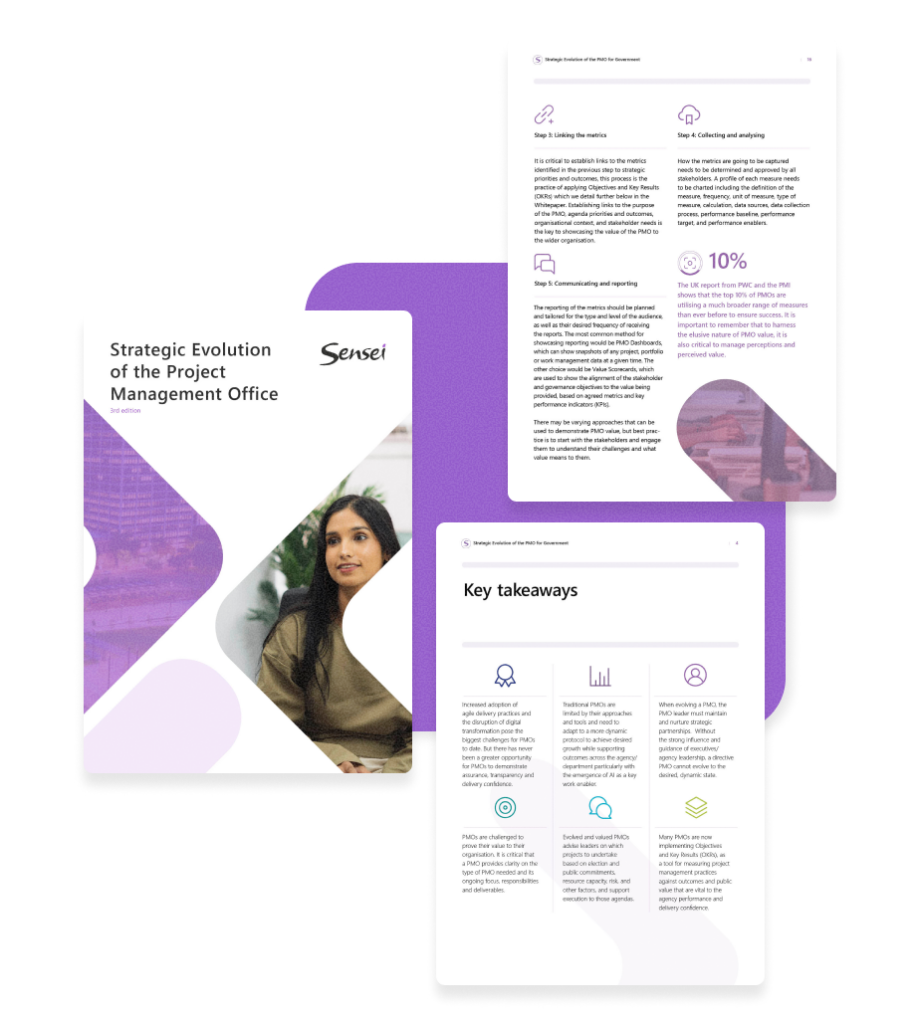
White paper: Strategic evolution of the PMO
Dive deeper into why transforming your traditional PMO approach may be one of the best steps forward for your PMO and how you can plan for the future and evolve your PMO into the strategic business partner your organisation needs. Access the whitepaper here.
A more strategic lens on PMO performance
One of the biggest shifts for PMOs is recognising that better performance is not just about having more reporting, more templates or tighter controls. It is about becoming more valuable to the organisation. Leaders want confidence in where effort and investment is being placed, assurance from embedded governance, which initiatives are at risk, whether resources are being used effectively and how delivery is contributing to broader business priorities. A PMO that can answer those questions clearly is doing more than coordinating activity. It is strengthening strategic execution.
This is why the PMO needs a strategic lens as well as an operational one. Good visibility is not just about seeing more. It is about seeing what matters. Good governance is not just about consistency. It is about making better decisions with less friction. And strong delivery environments are not only measured by whether projects are progressing, but by whether the organisation has enough clarity to adapt, prioritise and invest with confidence to achieve strategic outcomes.
Why people still matter
Technology, frameworks and reporting models all matter, but PMO improvement still depends heavily on people. Adoption, trust, and day-to-day usability often determine whether change actually sticks. A governance model may look strong on paper, and a platform may offer all the right features, but if teams do not understand how it helps them or leaders do not trust the system outputs, the intended gains rarely last.
This is where the human side of PMO transformation becomes an imperative. Better delivery environments are built through concerted change, realistic process design, clear communication, senior sponsorship and practical support that helps people work with more confidence. The strongest PMO improvements combine a clear transformation structure, with high visibility and buy-in, and an approach that respects the pressures teams are already under.
What to look for in a PMO solution
If the goal is to improve PMO performance, the right solution should do more than centralise information. It should help connect delivery to strategy, improve visibility without increasing administration, support different ways of working, reduce spreadsheet dependence and strengthen the quality of reporting and decision-making. It should also fit into the broader delivery environment rather than forcing unnecessary disruption.
Just as importantly, a strong PMO solution should come with practical guidance. Tools matter, but the way they are implemented, adopted and aligned to the organisation matters just as much. The real test is not whether a platform has a long feature list. It is whether it improves visibility, reduces friction and helps the PMO become more valuable to both delivery teams and leadership. This is also where the right combination of advisory support and enabling technology starts to matter. The white paper positions Altus as a platform built to support strategic alignment, hybrid delivery, data-driven decision making and integrated visibility, while Sensei’s broader approach is centred on helping organisations address the structural delivery problems that hold PMOs back. Together, that creates a practical combination of advisory support, implementation depth and enabling technology.
Conclusion
The current state of the PMO is defined by pressure, growing complexity and rising expectations. But it is also full of opportunity. The teams making the biggest gains are not necessarily doing more. They are creating better foundations for visibility, governance, prioritisation and decision-making, then supporting that change in ways people feel enabled to adopt.
For PMOs trying to move beyond manual effort, fragmented reporting and low strategic confidence, the next step is not simply more oversight. It is a better delivery environment. One that helps people see what matters, act with more confidence and connect the work underway to the outcomes the organisation is trying to achieve.
Ready to move beyond manual reporting and fragmented visibility? Get in touch to explore how your PMO can build greater confidence, improve decision-making and create a stronger delivery environment.