

AT A GLANCE
- Annual plans degrade by design: In fast-changing environments, even the most robust portfolio plan quickly becomes outdated.
- Adaptability beats precision: Leading organisations outperform competitors by re-prioritising quickly, not by building more detailed upfront plans.
- Prioritisation is a human process: Models and data help, but decisions are ultimately shaped through discussion, trade-offs, and judgement.
- PMO value is supporting decision quality: The real impact comes from enabling better, more transparent and traceable decisions, not just managing process or reporting.
Introduction
Many PMO leaders will recognise this scenario: after months of discussion, analysis and trade-offs, the portfolio is finally approved and priorities are locked in for the year ahead, only for a new executive initiative, funding shift or resource constraint to emerge weeks later and put those decisions back on the table. What felt settled during the planning process suddenly needs to be reconsidered, forcing teams to balance strategic intent with the realities of a changing business environment.
It’s easy to see this as a failure in planning and to think that a more thorough process or a better model would have solved it. But plans aren’t meant to last forever. The real question is: how ready is your organisation to respond when the plan needs to change? Because change is inevitable.
The myth of the annual portfolio prioritisation cycle
Portfolio planning often comes with the expectation that, with enough data and analysis, we can build a clear picture of what’s ahead. In practice, though, plans reflect a point in time. Priorities evolve, funding changes, new risks emerge and opportunities appear, often sooner than expected, making it common for the portfolio at the end of the year to look quite different from the one that was originally approved.
Consider this analogy: a weather forecast is useful, but a forecast for the next twelve months is largely speculative. This does not mean forecasting should stop; rather, organisations should develop the capability to adjust forecasts as conditions change.
The organisations that handle annual planning best aren’t always the ones with the most polished plan in June. They’re the ones who can adapt quickly and confidently when things change later in the year. It’s worth asking: is your organisation focused on building a better plan, or on building the ability to adapt when things change? These are two very different goals.
Practical tip: After your next annual planning cycle, try a quick retrospective focused on your planning capability. Don’t just ask if the plan worked—ask how long it took to re-prioritise when things changed, who needed to be involved, and what it cost the organisation. This will give you a real sense of your starting point.
The PMO decisioning role nobody writes in the job description
Part of the PMO’s job is administrative: collecting submissions, applying frameworks, producing reports and keeping leaders informed. These tasks are important, but they’re not where the PMO makes the biggest difference.
PMO leaders who make a real impact focus on helping their organisations make better decisions, even when the information isn’t perfect, which is almost always the case.
This means making the consequences of decisions clear before they’re made, not just documenting them after the fact. It’s about guiding conversations so leaders understand the bigger picture and the trade-offs involved, and keeping the process on track even when there’s pressure to take shortcuts. These are the skills that don’t show up in a RACI chart.
The key skill here is influencing without direct authority. PMO leaders don’t usually make the final decisions, but they shape the environment where decisions happen. This is very different from process management, and it’s not something you’ll often find in standard planning guides.
Practical tip: Before your next prioritisation workshop, get ready for the tough conversations. Spot the trade-offs that might be missed and make sure they’re front and centre. Sometimes a simple ‘if we add this, we defer that’ table is more powerful than any scoring model. The goal is to make it clear what will be displaced when something new is approved.
Why “evidence-based” decision-making is harder than it sounds
Most organisations aim for evidence-based portfolio decisions, but achieving this in practice can be challenging. It helps to talk openly about why this gap exists.
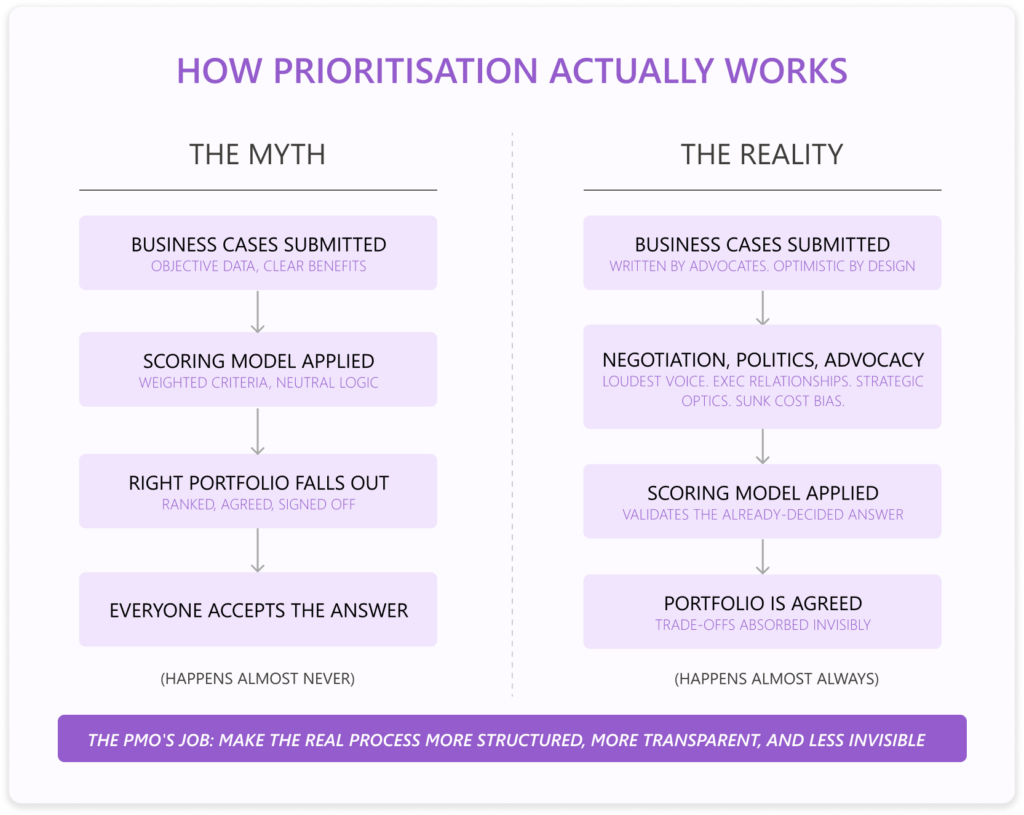
Business cases are often developed by the teams championing an initiative, which can make complete objectivity difficult. It’s natural for potential benefits to receive a lot of attention, especially when teams are competing for limited funding and resources. As a result, decision-makers are often working with information that has already been shaped by the pressures of securing approval.
Portfolio decisions involve comparing factors that do not always fit neatly together, such as strategic value, risk, time to benefit and resource needs. Scoring models can help, but they are only tools. A model that worked last year may not provide the right answers if your strategy has changed.
When the data is unclear, confidence can sometimes fill the gap. Occasionally, the most persuasive voice influences the decision, even if it is not the best answer. That does not mean we should give up on evidence. Making evidence-based decisions requires more than a scoring model; it needs a shared understanding of what good evidence looks like, an open process that brings challenges to light, and a clear view of where the data may fall short.
Practical tip: Add a ‘challenge step’ to your business case reviews. Ask someone who isn’t directly involved to take a critical look at the case. Assign this role ahead of time so it’s a positive, constructive process. The goal is to uncover hidden assumptions in benefit estimates, as these often hide the biggest risks.
The portfolio dashboard that feels like control (but isn’t)
When a dashboard presents a clear picture of priorities, progress and investment, it’s easy to feel confident that the portfolio is understood and under control. The reality is often more complex, as dashboards can only reflect the information that has been formally captured and maintained, while informal commitments, emerging priorities, shifting resource demands and work operating outside established governance processes may receive little visibility. As a result, there is often a meaningful gap between the portfolio that is being reported and the portfolio that teams are actually managing day to day.
Practical tip: Try a ‘shadow portfolio’ exercise each quarter. Talk to a few delivery managers or team leads to find out what their teams are actually working on. Compare this to your formal portfolio. The differences will highlight your real governance challenges and often tell you more than any dashboard update.
Prioritisation is a conversation, not a calculation.
It’s easy to think that picking the right criteria and weights in a prioritisation model will give you the perfect portfolio and everyone’s agreement. In reality, it doesn’t work that way, not because the models are flawed, but because that’s not how decisions are made.
Prioritisation is mostly a social process as models give us structure and language, but real decisions about strategy, risk and trade-offs come from discussion, negotiation and sometimes disagreement. That’s not a lack of rigour; it’s just how important decisions get made.
The PMO’s job isn’t to remove the human side of decision-making, but to make it more structured, open and productive. This means designing processes where the cost of any approval is clear, what gets deferred is made explicit, and making sure trade-offs are discussed openly, not hidden in the plan. A PMO that calmly guides these conversations and uses data to support decisions, without being defensive or overly deferential, adds real value. On the other hand, a PMO that just runs the model and shares results is likely to be left out of the real decision-making.
Practical tip: At your next prioritisation session, try a ‘displacement rule’. For every new initiative added above your resource limit, the team must say what will be deprioritised. Even if nothing changes, calling out the displacement makes the trade-off clear. This moves the conversation from ‘should we do this?’ to ‘what are we willing to give up for this?, which is the real question.
Scenario planning is a mindset, not a feature.
When people talk about scenario planning in portfolio management, the focus is often on tools such as modelling different combinations, testing budgets, or comparing resource profiles, these are helpful, but they miss the real point of scenario planning. Scenario planning is really about reducing overconfidence by helping us ask tough questions about our assumptions and how solid they are. This way, we can talk openly about what might go wrong, like delays or missed targets, before problems actually happen.
Organisations that do this well don’t always have the best models. Instead, they build a culture that accepts uncertainty and views discussing risks as smart, not negative. Creating this culture is harder than building models, Tt takes PMO leaders willing to ask the tough questions, even when it’s uncomfortable, and executive teams open to honest answers.
Practical tip: Add a ‘what would break this?’ step to your big investment decisions. Before you approve a business case, ask the sponsor to name the top two or three critical assumptions and explain what the plan is if those don’t hold. The aim isn’t to block the initiative, but to help your organisation handle uncertainty with confidence.
Measuring the right things
PMO leaders are often measured by delivery metrics like on-time completion, staying on budget, and meeting scope. These matter, but they only show how well the organisation delivered on past decisions. A better way to measure PMO effectiveness is by looking at the quality of the decisions made.
This involves assessing not just if the portfolio was delivered, but also if it was the right portfolio. It examines whether prioritisation was clear, whether trade-offs were identified early to avoid crises, and whether the organisation’s planning improved during the year. These factors are more difficult to measure and report to leadership, but they have a compounding impact.
Practical tip: At the end of your financial year planning cycle, conduct a "decision quality" review. Select five major prioritisation decisions from the year and evaluate whether they were the right choices, what information was available but not acted upon, and what unexpected outcomes could have been anticipated. The purpose is not to assign blame, but to foster learning and continuous improvement.
The reframe
Financial year planning often demands a significant investment of time and energy, despite the fact that priorities, funding and delivery realities can change shortly afterwards. That’s why some of the most valuable outcomes come not from the plan itself, but from the conversations, trade-offs and decisions made along the way.
The PMOs that create the greatest impact tend to view planning as more than an annual exercise. They use it to strengthen decision-making, build alignment across stakeholders and develop a clearer understanding of how the organisation responds when priorities inevitably shift.
Q&A
Q1: Why does a well-developed portfolio plan become outdated so quickly?
A: Even the most carefully developed portfolio plan is based on a set of assumptions that are true at a particular point in time. As business priorities shift, new opportunities emerge, budgets change and resource constraints evolve, organisations are often required to revisit earlier decisions. Rather than viewing this as a sign the planning process has failed, it’s more useful to recognise it as a natural response to a changing environment.
Q2: What is the most important capability for effective portfolio management?
A: The ability to adapt. While planning provides direction and alignment, long-term success often depends on how effectively an organisation can respond when priorities change. Organisations that can re-evaluate decisions, reassess investments and adjust course when required are generally better positioned than those focused solely on creating the most detailed plan from the outset.
Q3: Why don’t prioritisation models alone lead to better decisions?
A: Prioritisation models play an important role by bringing consistency and structure to decision-making, but they rarely tell the whole story. Decisions about investment, risk and strategic value still rely on judgement, discussion and an understanding of the broader organisational context. The conversations around the data are often just as important as the data itself.
Q4: How should PMO effectiveness be measured?
A: Delivery outcomes will always matter, but they only provide part of the picture. Effective PMOs also help organisations make better decisions by creating visibility, facilitating informed trade-offs and ensuring risks are understood before commitments are made. In many cases, the quality and consistency of decision-making can be just as valuable as the delivery results themselves.
These are the kinds of questions we love exploring with PMO leaders who are navigating them in their own organisations. If any of this sounds familiar, we’d be glad to chat.

Want to take this further?
Measuring delivery performance is only part of the picture. Read Altus’ article on ‘KPIs Every Strategic PMO Should Track’ to explore how leading PMOs measure strategic impact, value delivery and decision-making effectiveness.