
Executive summary
Interest in artificial intelligence (AI) across Project Portfolio Management is high and growing. PMOs, project managers and executives are all asking where AI can help improve delivery outcomes, reduce overhead and support better decisions. Despite this interest, real adoption remains low across most organisations.
Where AI is delivering value today is largely focused on efficiency and insight rather than autonomy. The biggest benefits are showing up in reduced administrative effort, faster reporting, improved interpretation of data, and better preparation for governance discussions. Fully autonomous decision making, optimisation and scheduling remain largely theoretical in most environments. This has created a clear gap between expectation, often driven by AI hype, and operational reality. This article explores the current state of AI in Project Portfolio Management and what that gap means in practice
Why AI matters in modern PPM
Portfolios are becoming more complex, not simpler. Organisations are running more initiatives in parallel, under tighter funding constraints, with higher expectations of transparency and measurable value.
At the same time, PMOs are increasingly overloaded with administration. Governance artefacts, status reporting, financial controls, and assurance processes consume significant effort, often at the expense of active support to decision makers.
This also limits the ability of many PMOs to progress in maturity. Areas such as schedule baselining and tracking, resource capacity planning and portfolio scenario planning are widely recognised as critical, but often underdeveloped due to lack of capacity and competing priorities.
This creates a clear shift in focus for modern PPM. The objective is no longer simply managing data but supporting better and faster decisions. AI matters because it offers the potential to reduce low-value effort and create capacity for PMOs to focus on higher-value capabilities, elevating their role to a strategic decision support function rather than a reporting factory.
Current adoption landscape
Most AI adoption in PPM today is fragmented and informal.
At an individual level, many project managers are using general AI tools to help draft status updates, refine risks, summarise meetings or structure communications. These activities sit outside the PPM system and are largely invisible to the organisation.
Some teams and PMOs are running small pilots, often focused on reporting, document generation, or knowledge retrieval. These pilots are typically time-bound and exploratory, with limited integration into core PPM tooling.
Enterprise‑wide embedding of AI into PPM platforms, governance processes and operating models remains rare. Very few organisations have moved beyond experimentation into sustained, scaled adoption.
Where AI is delivering value today
The most credible AI value in PPM today sits in four areas.
First, reducing administrative effort. AI can assist with drafting status updates, consolidating inputs, summarising notes, and maintaining registers. This does not eliminate governance, but it can significantly reduce time spent on mechanics. There is a consistent push to reduce or eliminate admin overhead for PMs.
Second, improving reporting speed and clarity. AI can help tailor reports for different audiences, highlight trends, and explain variance in plain language. This improves comprehension without changing the underlying data.
Third, supporting governance and decision preparation. AI can surface relevant risks, issues, dependencies and financial movements ahead of reviews, helping PMOs and executives focus discussions where it matters.
Finally, AI is most effective at surfacing insights rather than making decisions. It can point to patterns, correlations, and anomalies, but still relies on human judgement to interpret and act.
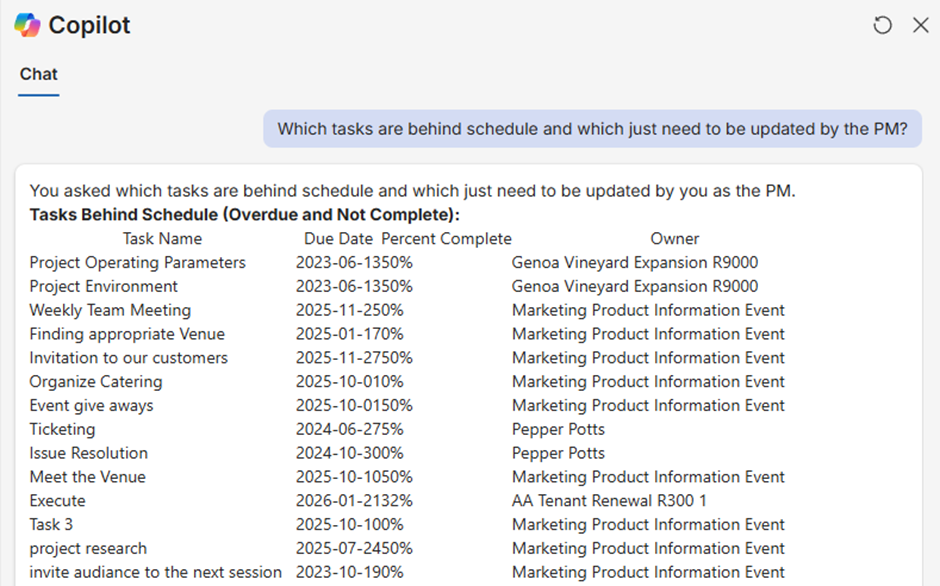
Scheduling remains a major limitation
Scheduling is one of the most constrained areas for AI in PPM.
There are limited credible AI‑driven scheduling options in enterprise environments. Constraint‑based scheduling remains complex, highly contextual and sensitive to data quality.
Planner Premium’s Project Manager Agent reflects Microsoft’s current attempt to showcase AI‑driven scheduling capability, but it is not yet delivering meaningful outcomes in real‑world PPM environments.
Sensei has explored both the auto generation of tasks and the use of the PM Agent to autonomously complete activities. While tasks can be created or added, the capability stops there. Tasks cannot be meaningfully updated, linked through dependencies, or aligned to dates and resource allocations. This limits their usefulness in a PPM context, where the value of a schedule relies on structure, relationships and ongoing maintenance rather than simple task generation. Additionally, the PM Agent will only provide text responses within the task’s notes.
While it demonstrates direction and intent, the functionality remains immature and lacks the depth required to manage complex, dependency‑driven schedules at scale. As a result, it currently serves more as a proof of concept than a practical alternative to established scheduling approaches.
Microsoft Project Professional currently lacks effective AI scheduling features. While users might copy/paste details out for AI processing and paste them back in, this method is risky.
AI is better at supporting thinking about schedules than executing them. It can explain drivers, highlight pressure points and suggest scenarios, but it does not replace established critical path and resource‑based approaches. Scheduling remains an area where a high-level of manual effort is still required.
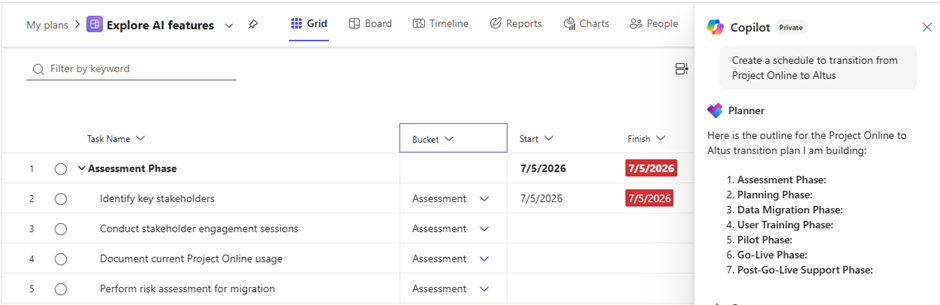
Copilot in Planner can create the project schedule from scratch. It creates tasks and parent-child relationships, grouped by bucket/phase.
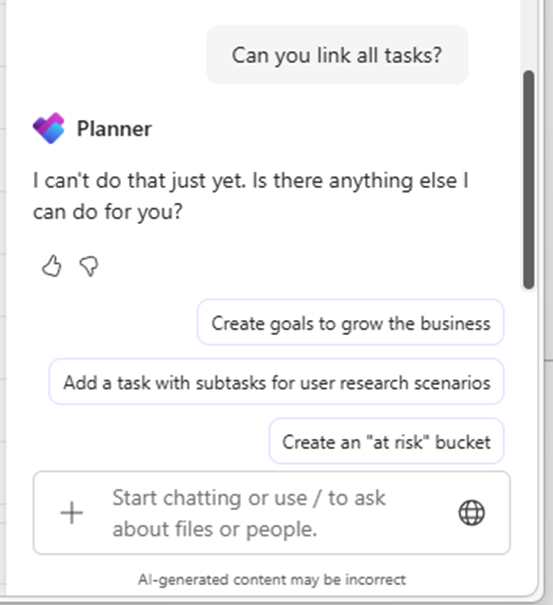
However, after initial creation there are limitations on what further actions can be completed by Copilot.
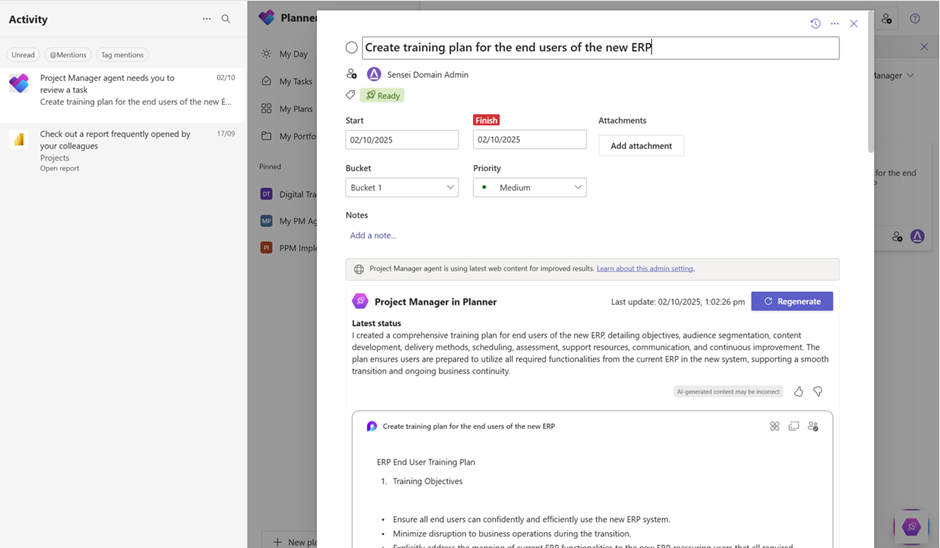
The Project Manager Agent in Planner can go off and do tasks you assign to it, returning results within the task details.
Structured data still dominates PPM, but change is starting
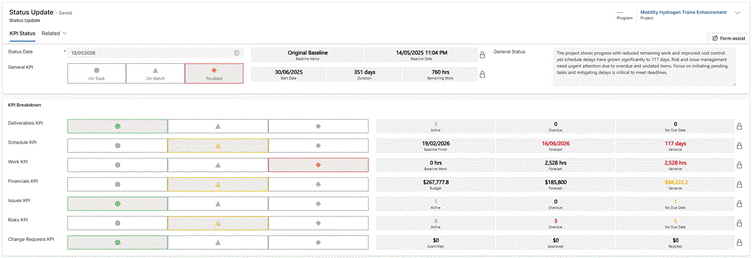
PPM today still relies heavily on structured data. Status updates, RAG ratings, milestones, forecasts, budgets and benefits all form the backbone of how portfolios are managed. These aren’t going anywhere anytime soon, largely because they are auditable, consistent and easy to compare, which is exactly what executives and governance bodies expect.
That said, there’s growing interest in reducing the amount of manual effort required to keep all of this up to date. Organisations are starting to look at whether signals from emails, chats, meetings and documents can be used to supplement or even replace some of that structured data entry.
At the moment, this is still very early. While there is clear potential to infer project status based on language, sentiment, and real activity, most organisations are not ready to rely on that alone. Auditability, accountability, and explainability still matter too much.
It will be interesting to see whether enough reliable information can actually be gathered from emails and chat to support formal artefacts like Project Status Reports, without someone explicitly writing them.
The chatbot pattern
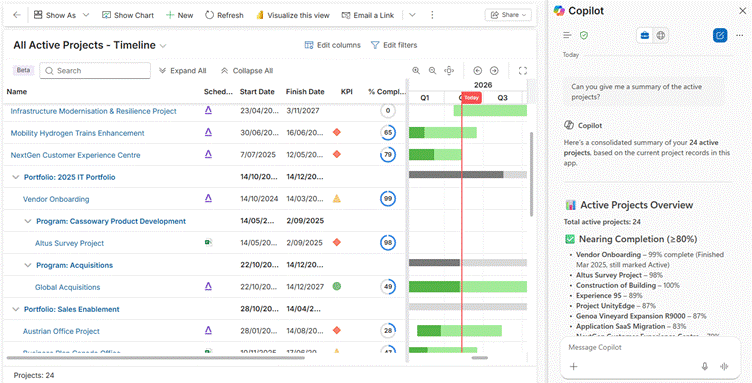
The most common entry point for AI in PPM is a chatbot layered over project and portfolio data.
This improves accessibility and engagement. Users can query data conversationally instead of navigating complex tools or creating bespoke reports each time.
However, this pattern still depends on asking the right questions. Experienced users can benefit, while less experienced users may not know what to ask, what data is available, or how to interpret responses.
Chatbots improve access to information and make it easier to retrieve project and portfolio insights, however, they do not inherently complete actions, enforce standards, or provide passive governance. They rely on user prompts rather than proactively identifying issues, and they do not ensure that key activities such as status updates, risk management, or approvals are completed consistently.
What is emerging next
The next wave of AI in PPM is likely to be quieter but more impactful.
We are starting to see early examples of AI agents aligned to PMO policies, operating within defined guardrails rather than open-ended prompts. These agents are designed to support specific activities such as preparing status updates, highlighting risks, or guiding users through governance processes in a consistent way.
Conversational interfaces may begin to replace some traditional navigation, particularly for executives who want quick, high‑level insights without interacting directly with complex tools. Over time, this is likely to become more guided, reducing reliance on users knowing exactly what to ask.
There is also growing potential in AI-driven scenario evaluation. Instead of static portfolio views, AI can help assess the impact of different decisions such as funding changes, resource constraints, or shifting priorities. This creates an opportunity for more dynamic portfolio planning, where tradeoffs can be explored more quickly and with better context.
Similarly, risk scoring is starting to emerge as a more advanced capability. AI can analyse patterns across historical data, delivery performance and current signals to highlight potential risk levels or trends earlier than traditional reporting. This does not replace formal risk management, but it can provide an additional layer of insight to support earlier intervention.
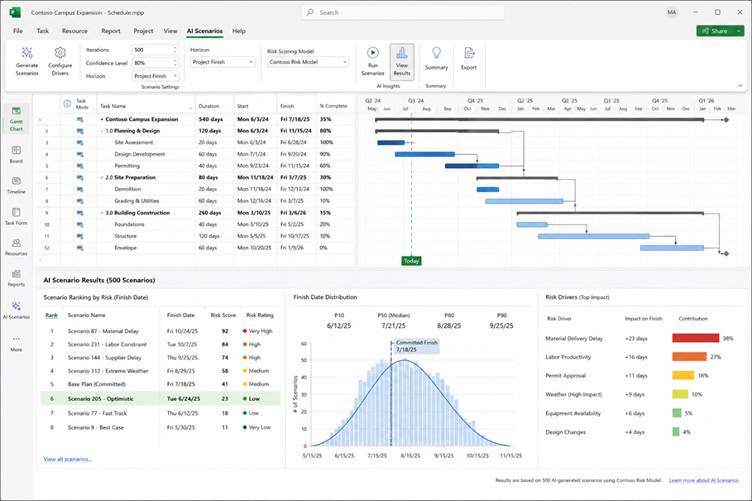
A mock-up of a potential future state of project planning, scheduling and risk forecasting. PMs focus on mitigating the risks which AI proposed based on scenario evaluations.
Practical guidance for PMOs
PMOs should start with pain points, not tools. AI should be applied where effort is high and value is low.
Small, focused experiments are preferable to broad rollouts. Governance and knowledge foundations should be strengthened before layering on AI.
Most importantly, AI should be treated as a PMO capability, not a side experiment. It needs ownership, standards, and integration into existing ways of working.
POCs can be stood up quickly by simply using ‘copy and paste workflows’ into general AI tools, allowing teams to test ideas, validate use cases and demonstrate value without waiting for fully integrated solutions. This provides a low‑effort way to explore benefits early, before developing more formal tooling, agents or automated workflows.
Conclusion
AI in PPM is certainly here and being used regularly. The technology is moving faster than most operating models and governance structures.
Successful organisations will make thoughtful, practical choices, prioritising clear value and disciplined execution. While the change is gradual rather than sudden, those who approach it carefully can see where things are heading.
How does your organisation’s AI implementation compare to others? To gauge where your organisation is on the AI in PPM journey, you can download the recent 2025/26 Benchmark report: AI in project management or get in touch to find out how organisations are embarking on their AI in PPM journey.